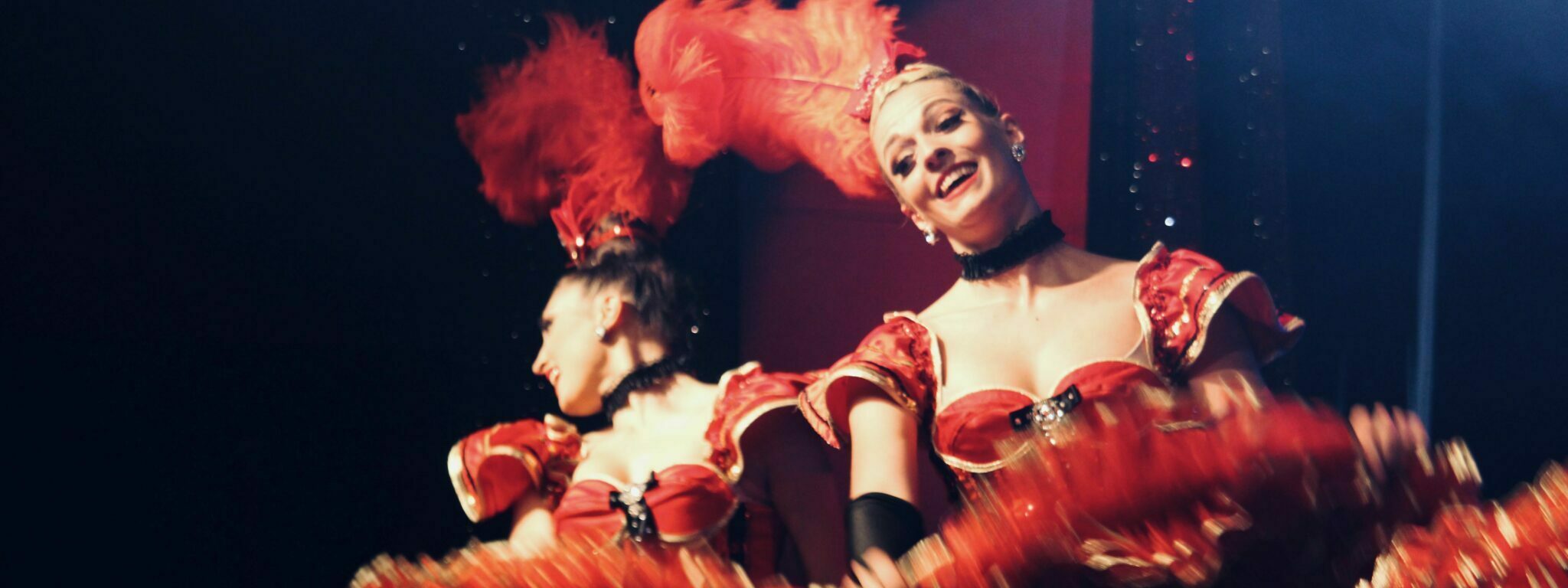
Whether you are a connoisseur or not, the French Cancan resonates as a mythical dance, a symbol of pride for France on the international stage. A dance that was in vogue in the cabarets of Montmartre at the beginning of the 20th century, many music halls and regional cabarets continue to pay tribute to this quintessentially French specialty. Join us as we step back into the 19th century in the footsteps of the French Cancan.
Where does the French Cancan come from?
The “cancan” or the “chahut”: subversive dances
In the 1820s, amid the quadrille (a highly codified choreography danced by four couples), a minute of improvisation emerged: the “cavalier seul”. The aim? To perform chaotic, almost cathartic movements. Initially reserved for men, women soon began dancing solo as well, from 1829. The prevailing puritanism condemned this movement without reservation, as it offended public decency. A subversive means of expression, this dance—known as the “chahut” or “cancan”< from 1831 (1)—became a symbol of freedom and emancipation for women. Beyond that, the approach “opposes the authority of dance knowledge on which the system of transmission by ballet masters for theatrical dance is based” (2). The self-taught nature of the learning process is a form of “mockery and provocation toward the scholarly culture of dance”.
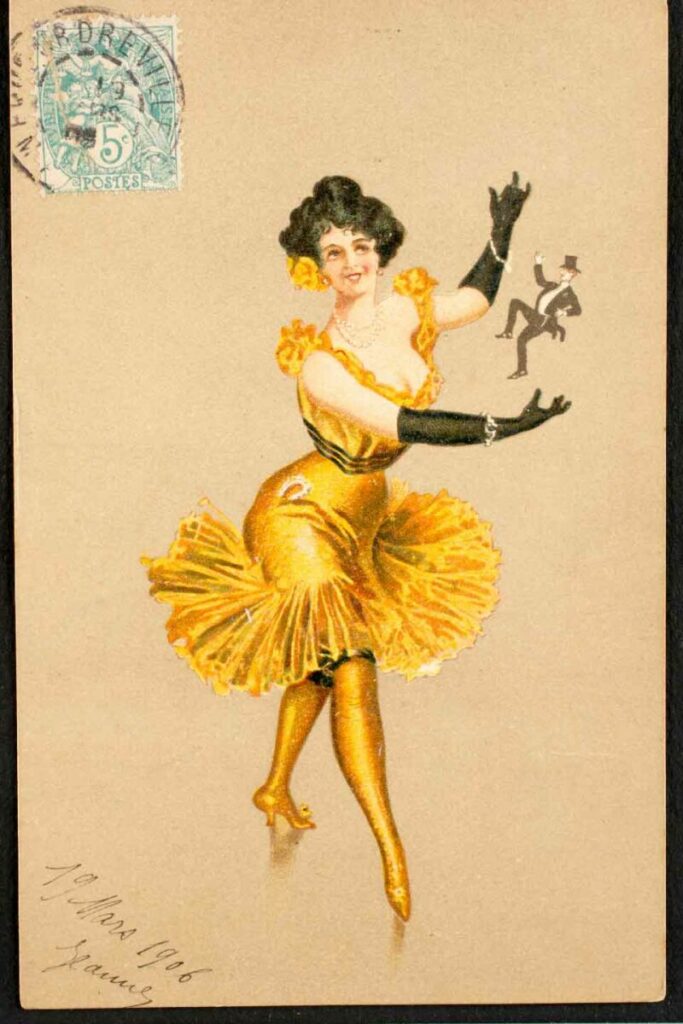
Vintage postcard / French Cancan[/caption]
The first “French Cancan” dancers: true stars
Gradually, Parisians and foreign tourists flocked to admire this provocative dance. The dancer Célestin Magador embodied it at the famous Mabille ball. The “chahut” spread to several cabarets in the capital under the July Monarchy (1830–1848) and would enjoy its heyday under the Second Empire (1852–1870) (3). Many women established themselves on the “chahut-cancan” scene, such as the dancer Rigolboche, who in 1857 invented the series of kicks consisting of raising and lowering the leg. A few years later, Jacques Offenbach
composed the “Galop infernal”, which would become the anthem of cancan dancers. In 1864, Charles Morton brought this committed dance to the United Kingdom under the name “French Cancan”. The dance became professionalized and an opportunity to gain financial independence. Dancers now earned more than men. Joseph Oller, one of the co-founders of the Moulin Rouge, also introduced the “French Cancan” to make it one of the cornerstones of his new venue. The star dancers then adopted names highlighting a physical trait or technical ability: “La Goulue was first nicknamed ‘Bottle-Emptier’; ‘Grille d’égout’ owed her nickname to her gap-toothed smile; ‘Nini Pattes-en-l’Air’ to her ability to lift her leg—without forgetting ‘Rayon d’or’, ‘Cha.Hu.Ko’” (4). These nicknames contributed to their fame.
Codification of the “French Cancan”
At the beginning of the 20th century, the “French Cancan” was no longer the preserve of a few famous cabarets and music halls; it became a classic. “What ‘the Moulin’ presents already resembles a tourist attraction that symbolizes Paris, and that is precisely what visitors to the World’s Fair come to seek” (5). This dance, which shaped the identity of several cabarets, now represents Paris and France beyond its borders. Many dancers at the Cabaret de Licques have a fascination with this wild dancethat continues to delight audiences just as much.
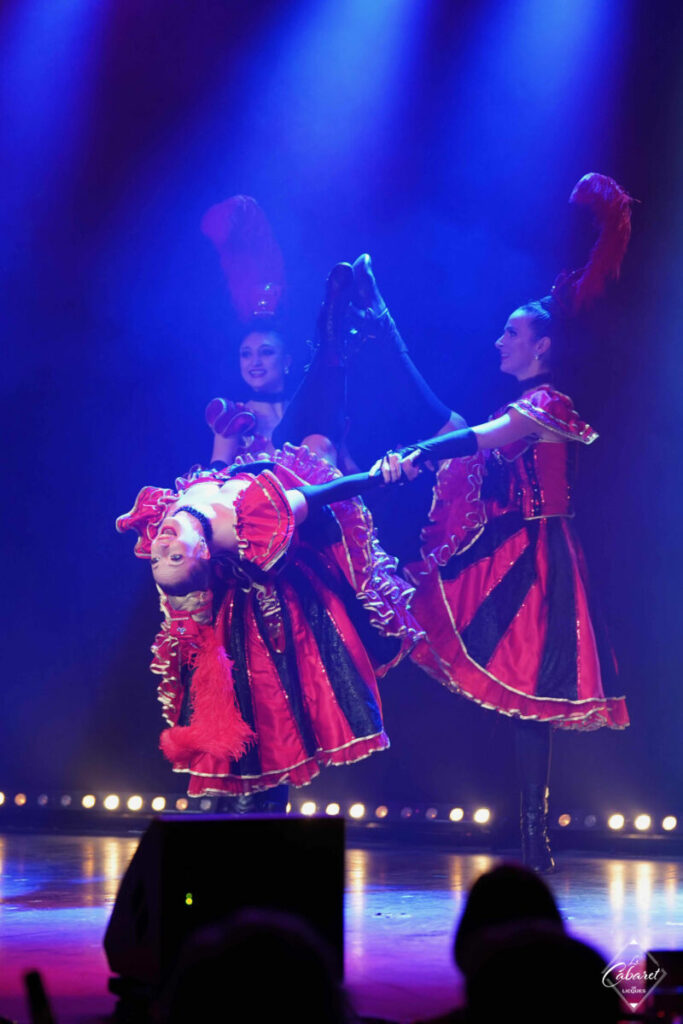
the cabaret dancers create a cathedral[/caption]
Sources:
(1) Gasnault, F. (2018, January 2). Parisian nights: Chahut, cancan and galop infernal [Video]. https://www.youtube.com/watch?v=YGeoPOjIEbA
(2) Camille Paillet, “The feminization of the chahut-cancan under the Parisian Second Empire”, Recherches en danse [Online], 3 | 2015, posted online January 19, 2015, accessed March 21, 2023. URL: http://journals.openedition.org/danse/902 ; DOI: https://doi.org/10.4000/danse.902
(3) KALIFA Dominique, “The Second Empire, a ‘Belle Époque’?”, Histoire, économie & société, 2017/3 (36th year), p. 61-71. DOI: 10.3917/hes.173.0061. URL: https://www.cairn.info/revue-histoire-economie-et-societe-2017-3-page-61.htm
(4) PERAULT Sylvie, “That’s Paris! The Moulin Rouge Ball and its girls”, Ethnologie française, 2012/3 (Vol. 42), pp. 493–501. DOI: 10.3917/ethn.123.0493. URL: https://www.cairn.info/revue-ethnologie-francaise-2012-3-page-493.htm (5) Ibid.